

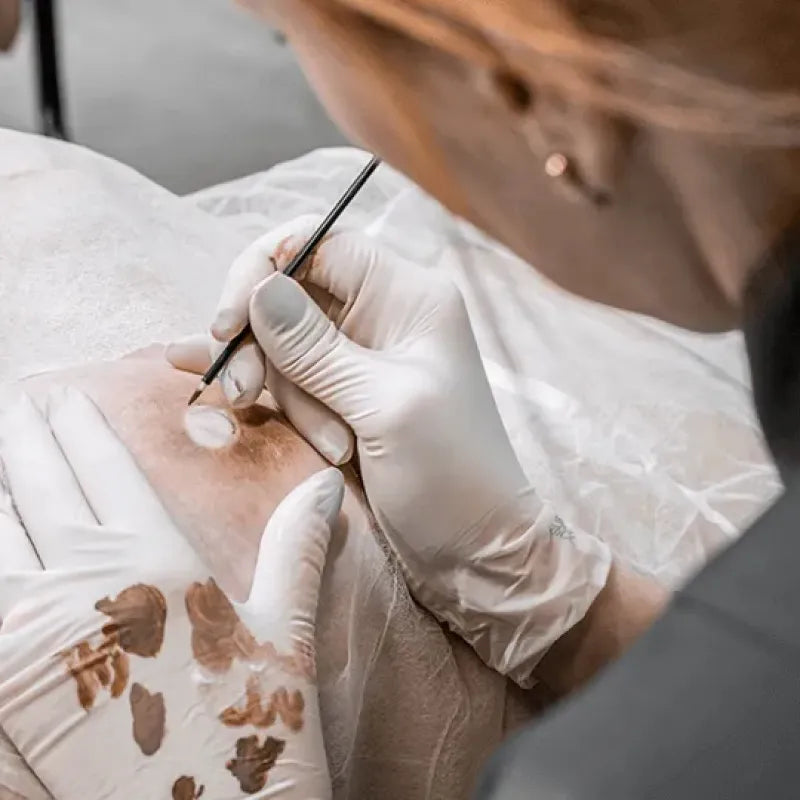
If you've been quietly Googling this question at midnight, you're not alone. Here are honest answers.
The Question Most Women Are Afraid to Ask Out Loud
Months — sometimes years — after mastectomy, a question starts to surface. Not in the oncologist's office. Not in the surgical follow-up. Usually at home, late at night, in a search bar.
Is there a way to make it look... like before?
Areola micropigmentation is one of the most powerful answers to that question. It is also one of the most misunderstood. So let's answer it directly, without clinical distance or marketing gloss.
No. It Is Not the Same as a Tattoo.
This is the question we hear most often — and the answer matters.
Areola micropigmentation and conventional body tattooing share a superficial similarity: both involve pigment and a needle. Everything else is different.
| Areola Micropigmentation | Conventional Tattoo | |
|---|---|---|
| Equipment | Medical-grade needle, specialized device | Standard tattoo machine |
| Pigment depth | Superficial dermis — precise and controlled | Deeper layers |
| Clinical context | Oncological case, surgical clearance required | No medical context |
| Practitioner training | Specialized in post-mastectomy reconstruction | General tattooing |
| Goal | Anatomical restoration — replicating natural areola | Artistic expression |
This is a medical procedure performed by a specialist — not a cosmetic service. The distinction is not semantic. It affects safety, outcome, and suitability for post-mastectomy skin.
What Does the Procedure Actually Involve?
Areola micropigmentation recreates the natural appearance of the areola and nipple using specialized pigment implantation applied with a medical-grade needle. The process is:
- 🔹 Minimally invasive — no surgery, no general anesthesia
- 🔹 Performed at our Dallas, TX studio — in person only
- 🔹 Customized to your skin tone, anatomy, and the specific characteristics of your reconstruction or flat closure
- 🔹 Conducted exclusively by Roberta Peixoto — 15+ years, 500+ areola reconstruction cases, international speaker and author of scientific articles on the subject
The result is a natural-looking areola and nipple — matched to your coloring, your proportions, and your desired outcome.
Is It Right for Me?
Areola micropigmentation may be a meaningful option if:
- ✅ You had a mastectomy and have completed the primary phase of recovery
- ✅ Your surgical wounds have fully healed
- ✅ You've considered your options and feel ready for a more permanent step
- ✅ You want a restoration that doesn't require ongoing maintenance
It may not be the right moment if:
- ❌ You are fewer than 12 months post-surgery
- ❌ Your healing is still ongoing or your skin is not yet stable
- ❌ You have not received clearance from your surgeon or oncologist
Timing Matters — and There Is No Rush
This is perhaps the most important thing to understand about Stage 03: there is no timeline, no expectation, and no pressure.
Many women choose their silicone prosthetic as a long-term solution — and that is a completely valid, permanent choice. Micropigmentation exists for those who want to go further — whenever, if ever, that moment comes.
Most patients who choose micropigmentation do so 12 or more months after surgery, once healing is complete and they've had time to process where they are and where they want to go. Some come at 18 months. Some at five years. Some never — and that's okay too.
Medical clearance from your surgeon is required before the procedure. RmonyCare works in coordination with your medical team to confirm that timing and healing are appropriate for your specific case.
Who Performs It — and Why That Matters
Areola micropigmentation after mastectomy is not a procedure for generalists. The post-mastectomy skin, the oncological context, the anatomical precision required — these demand a practitioner with specific expertise.
Roberta Peixoto, founder of RmonyCare, has dedicated 15+ years exclusively to this work. 500+ cases documented. Scientific articles published on areola reconstruction. International recognition in 20+ countries. Awarded a US Green Card for Extraordinary Ability in her field.
Every micropigmentation procedure at RmonyCare is performed by Roberta — not delegated, not outsourced.
Curious? The First Step Is Just a Conversation
If you're considering this option — or simply want to understand whether it's right for your specific case — a free consultation costs nothing and answers everything.
No commitment. No pressure. Just clarity about what's possible, and what the process looks like for someone in your exact situation.
📍 Stage 03 is optional. It's available when you're ready — and only when you're ready.
Learn More About Micropigmentation → Book a Free Consultation →
About the author: Roberta Peixoto has over 15 years of experience in oncological micropigmentation, has completed 500+ areola reconstruction cases, and is the founder of RmonyCare and of Roberta Peixoto Academy.
Share:
What Nobody Tells You About Losing Your Areola & Nipple After Breast Surgery
Surgery Is Over. So Why Does the Hardest Part Feel Like It’s Just Beginning?